Reuvers® real-time breathing zones

The deeper you relax,
the better you perform.

Your nervous system knows the right breathing intensity.

Now you can measure your state. No need to guess.

What course participants say

Real-time zones show your nervous system state and give every breath hold a quality mark. Here's what participants share.

Feedback from participants via WhatsApp and Zoom.

"I can feel the shift from doing to being."

"I sleep better. I rest better."

"I don't need to perform. I can just breathe."

"The holds feel hypnotic. It's meditative."

"My life quality has gone up."

"I feel more energy. I feel warmer."

"Being in a group keeps me accountable."

"I can breathe better in yoga class now."

"This is sustainable. I can do this for life."

"I'm not pushing anymore. I trust the method."

"It feels great to do these breathing exercises every day."

"I ran a marathon. I didn't expect to be able to run a marathon."

"I can feel the shift from doing to being."

"I sleep better. I rest better."

"I don't need to perform. I can just breathe."

"The holds feel hypnotic. It's meditative."

"My life quality has gone up."

"I feel more energy. I feel warmer."

"Being in a group keeps me accountable."

"I can breathe better in yoga class now."

"This is sustainable. I can do this for life."

"I'm not pushing anymore. I trust the method."

"It feels great to do these breathing exercises every day."

"I ran a marathon. I didn't expect to be able to run a marathon."

"I love the program. So much more enjoyable than my old breathing exercises."

"In two days, my breath-holds before and after sleep are so much longer."

"Feather breathing is so relaxing. I feel the difference immediately."

"I learned to sense my breathing response and keep it gentle."

"I can do weight training now without getting winded."

"I used to hyperventilate when speaking. Now I can talk without running out of breath."

"I thought relaxation and performance were opposite. Now I see they're connected."

"I'm learning to relax. I'm not trying to achieve something."

"I expected to learn breathing techniques. But I've exceeded my expectations already."

"This method teaches you to feel. Not just to push numbers."

"Feather breathing feels like a conversation with my body. It's not forced."

"I started at 13 seconds. Now I'm at 30 and climbing."

"I love the program. So much more enjoyable than my old breathing exercises."

"In two days, my breath-holds before and after sleep are so much longer."

"Feather breathing is so relaxing. I feel the difference immediately."

"I learned to sense my breathing response and keep it gentle."

"I can do weight training now without getting winded."

"I used to hyperventilate when speaking. Now I can talk without running out of breath."

"I thought relaxation and performance were opposite. Now I see they're connected."

"I'm learning to relax. I'm not trying to achieve something."

"I expected to learn breathing techniques. But I've exceeded my expectations already."

"This method teaches you to feel. Not just to push numbers."

"Feather breathing feels like a conversation with my body. It's not forced."

"I started at 13 seconds. Now I'm at 30 and climbing."

Individual experiences. Results vary.

Is This For You?

Four reasons people start breathing with zones.

Oxygen Efficiency

More oxygen from less air. Better physical and mental performance.

Right Intensity

Zones guide you to the intensity that gets the best results without triggering stress.

High Stamina

Become more resilient. Handle more with less effort.

Calm Energy

Practice leaves you calm, energized, and ready for the day.

Guessing vs Knowing

Your practice deserves real feedback. Zones make it visible.

Without Zones

  • You're practicing blind

    No reference point. No way to tell how you're doing.

  • You hit a wall

    Something isn't working, but you can't tell what.

  • You're guessing

    Higher level exercises require more precision.

With Zones

  • You see where you are

    After every round, you know exactly how you did.

  • You push with confidence

    If you overdo it, you see it immediately.

  • You earn a quality mark

    Every breath hold gets scored. Green means relaxed.

Consistent practice at the wrong intensity holds you back. Zones show you the right intensity to practice at today.

Two Distinct Practice Styles

They complement each other. Use whichever suits your moment.

Sitting

A meditative challenge

Stillness, breath holds, and reduced breathing. You sit, you relax, and explore the challenge. Don't go too far, don't go too easy.

Greener zones, better holds, smoother recovery. Go deeper.

Improve oxygen efficiency in stillness.

Walking

A physical challenge

Breathing intensity meets physical movement. You walk, you breathe, you build fitness. The zones help set your pace and effort.

Raise your oxygen consumption while using less air. Push further.

Improve oxygen efficiency in motion.

The deeper you relax, the better you breathe.
The better you breathe, the better you perform.

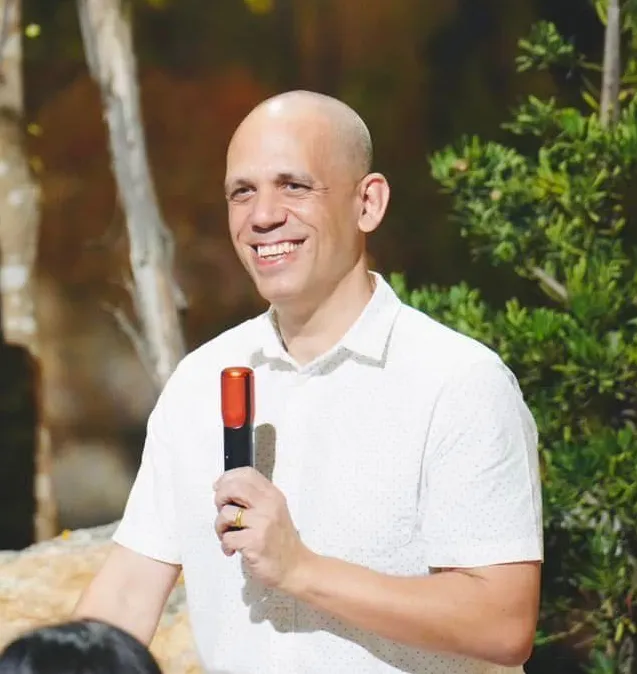
Drs. Ed Reuvers today
Drs. Ed Reuvers as a young Buddhist monk
Drs. Ed Reuvers with 2 Indian monks

The question behind the project

Why This Exists

I trained as a Buddhist monk for nine years, then spent 18 years as a Buteyko breathing instructor. Early on, I taught the strongest version of the method. It was impressively effective, but the intensity made it harder to sustain on the long-term. I adapted the approach to give people more control over their own intensity and encouraged lower intensity for long term results, but the question stayed with me: if the strongest version works best, is there no way to make it easier to do?

Over the last ten years, I took an increasingly experimental attitude to the practice. I was particularly interested in variants that allow higher training effectiveness while being softer on the nervous system. Getting closer to the nervous system required changes to the exercises that are not possible within the Buteyko framework.

It also required a completely new app with new exercise flows and a larger selection of exercise variants. The new app uses sensor-free stress detection to find your optimal intensity. Zones make the invisible visible. No equipment needed. And relaxation puts you in the best position to make a serious effort, once you're properly warmed up. Based on the new exercise style, we also developed a walking version, allowing you to practice in a more physically active way.

Learn the Foundation for free.
Move up from there.

Free

Foundation Course

Sign up and your course starts. Go at your own pace in the app. Join the Foundation Weekend to go deeper with an instructor.

Free Foundation Course View paid courses, events, and private coaching

Go Further

After Foundation, continue with the Immersion and Summit courses. Or join a live weekend event.

View paid courses, events, and private coaching

3

Programs

  • Foundation
  • Immersion
  • Summit

10

Exercise Styles

  • Intro, Soft, Soft+, Medium,
  • Medium+, Strong, Strong+,
  • Extreme, Complete, Walking

100+

Combinations

  • 14 levels per style:
  • Levels 1–13 plus
  • recovery level

Every aspect of the exercise is customizable. Everyone is unique. Work with what your body can handle and your mind enjoys.

How Breath Zones Work

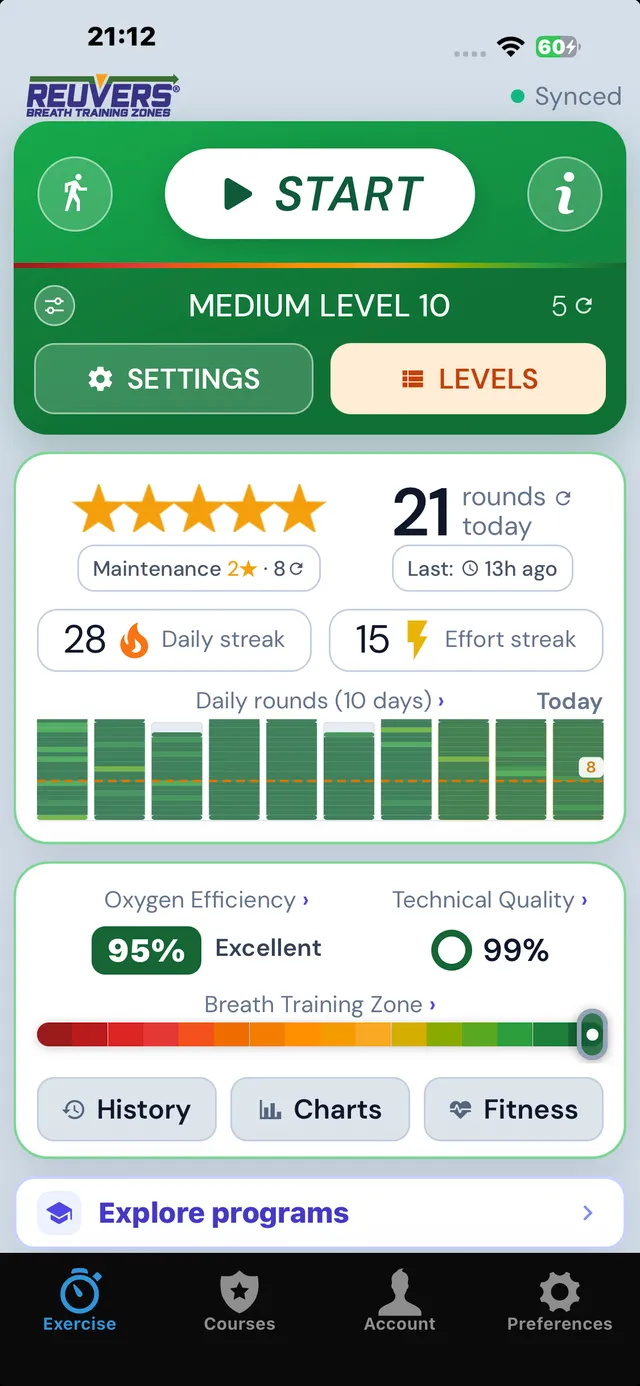
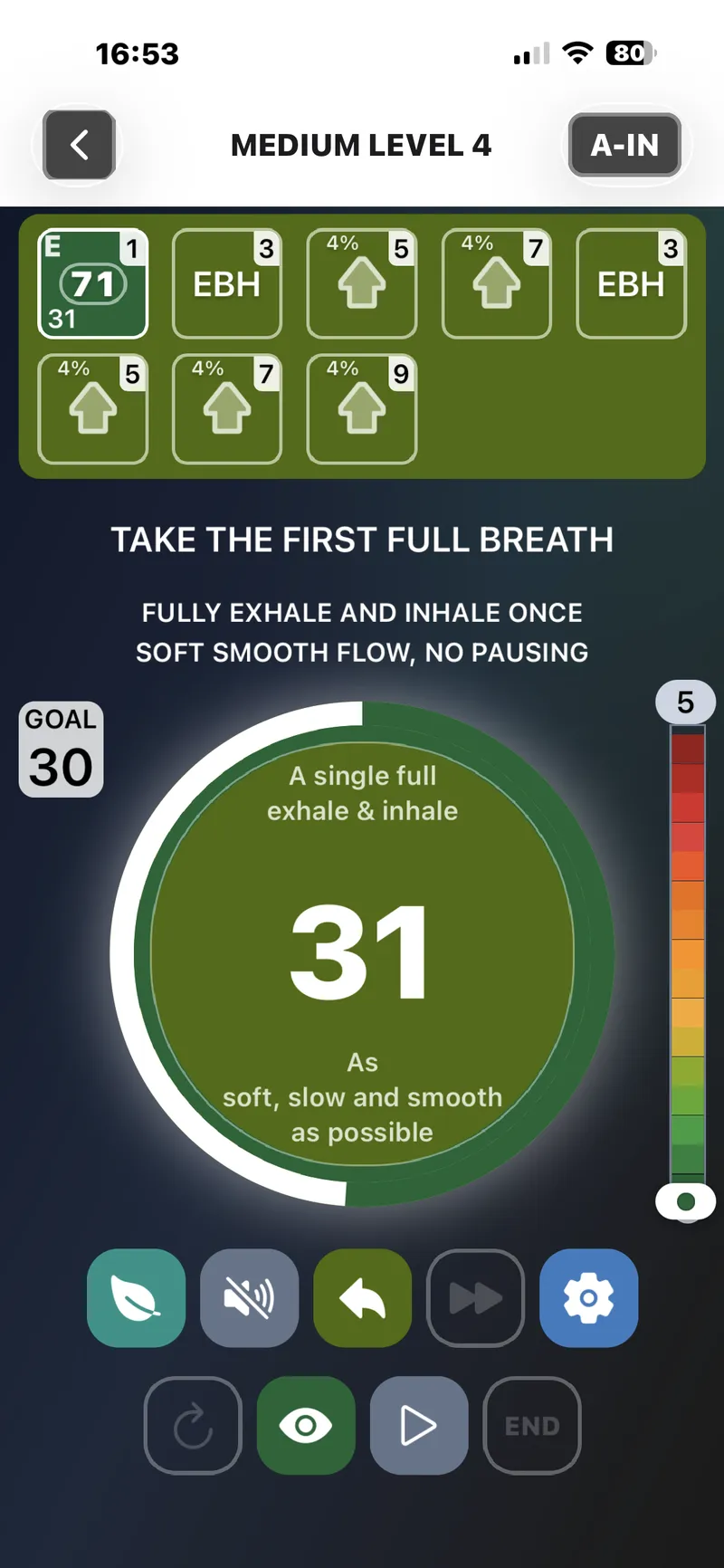
Zones show your nervous system state in real time. Like heart rate zones, but for breathing and relaxation.

Green zones activate rest and relaxation. Orange and red zones drive sympathetic activation. In the higher levels, we can deliberately move between states.

Reuvers® Breath Training Zones

Stress Relaxation

Know Your State

Two measurements, one clear picture.

A comfortable breath hold and the quality of your first breath afterwards.

A green score is a quality mark. It means you stayed relaxed.

Real-Time Guidance

Your exercise adapts in real time:

  • Green zones: You stayed relaxed, so for the next round, we raise the target a bit.
  • Red zones: You pushed too hard, so the next round has an easier target.

Train in the Flow

Three levels of intensity, all zone-guided:

  • Gentle practice: Relaxed breathing, easy targets.
  • Moderate practice: Longer holds, higher targets.
  • Powerful practice: Deep relaxation powers a peak effort.

Everyone's different. Instructors help you progress safely.

Follow the timer and audio cues. Zone tracking happens automatically. You focus on your breath.

What's Different

Traditional exercises to improve oxygen efficiency have four limitations. We resolve all four.

Problem 1: Years-long preparation

Traditionally, years of preparatory practice were required before accessing the most effective breathing exercises.

Solution 1: Start today.

Our program is designed so you can start practicing and get results from day one. Most people notice real changes within 60 days.

Problem 2: Instructor dependency

Results depend on having a highly skilled teacher. But it takes years and thousands of students to become one.

Solution 2: The app listens to you.

The app reads your breathing and guides you directly. Instructors benefit from the app analysis too.

Problem 3: No stress detection

Intense breathing exercises can create subtle forms of tension and emotion without you realizing it.

Solution 3: See your stress level in real time.

The app shows your nervous system state in real time, helping you relax deeper.

Problem 4: One size fits all

One intensity for everyone doesn't work. For some it is too low, for others it is too high.

Solution 4: You choose your level.

Do what works best for you. Choose your pace and level. The exercise adapts.

The Practice

What you do, how it helps, and what changes.

What you practice
How it helps
What changes
Power Breathing
Respiratory strength
Better fitness
Breath Holds
Oxygen efficiency
Stress resilience
Slow + Deep Breathing
Deep mental states
More energy
Feather Breathing
Better circulation
Better sleep
Contemplation
Nervous system balance
Mental clarity
Walking Sessions
Oxygen efficiency in motion
Physical stamina
Slow-Mo Jog
Advanced oxygen training
Aerobic capacity

Oxygen Efficiency: The Science

Oxygen efficiency training is backed by decades of research. These are the results.

7–8s

Faster per km after breath-hold training

+24%

EPO production after repeated breath holds

60%

More efficient CO₂ response when trained

VO₂max

Better running economy with nasal breathing

+9.5%

Hemoglobin after breath-hold diving

+30.5%

Longer breath-hold from training

Meet Our Instructors

Certified instructors ready to guide your breathing practice.

Upcoming Events

Programs run throughout the year. Start free, then progress through the stages at your own pace.

Common Questions

Here are answers to common questions about the Reuvers® program.

Why does breathing less give you more oxygen?

When you breathe more than your body needs, your blood holds onto its oxygen more tightly, delivering less to your cells. Breathing less allows your blood to release more oxygen where it's needed. More oxygen from less air. The mechanism behind this is CO₂ tolerance. When you breathe less or hold your breath, your CO₂ tolerance increases. This triggers your blood to release more oxygen to your cells. The physiology behind this is called the Bohr effect, and it's been in every physiology textbook since 1904. "Oxygen efficiency" is what you experience. CO₂ tolerance is how it works. The exercises train both. This is the reason targeted breathing training produces much larger effects than generic breathing exercises.

What makes this different from other breathing apps?

Mechanism. Most breathing apps guide you to breathe slowly. That helps, but research shows the effect is small. This app targets oxygen efficiency directly through reduced breathing and breath holds, which produces much larger effects. The app also includes sensor-free stress detection that finds your optimal intensity, so you train at the right level without any equipment.

Is there scientific evidence?

Yes. The core mechanism is backed by published research on oxygen efficiency, CO₂ tolerance, and breathing performance going back decades. Full citations and study details are on our research page.

What results can I expect?

The exercises train your body to get more oxygen from less air, through reduced breathing and breath holds. Regular practice typically improves physical fitness, energy levels, relaxation, sleep quality, stress resilience, recovery speed, and mental clarity. Individual results vary based on consistency, frequency and intensity of practice. For the research behind the method, see our research page.

What makes this different from other breathing apps?

Mechanism. Most breathing apps guide you to breathe slowly. That helps, but research shows the effect is small. This app targets oxygen efficiency directly through reduced breathing and breath holds, producing much larger effects. The app uses sensor-free stress detection to find your optimal intensity, the level where training is most effective without triggering a stress response. No equipment needed. Your breath training zone shows where you are in real time, and the app adapts each round. The 30-day program adds expert instructor support for those who want guidance at higher intensities.

How does the app optimize my practice?

The app guides you from start to finish of each session, recording your scores, tracking durations of each stage, and helping you stay in the optimal breath training zone. It monitors your zones during each round and gently guides you to avoid overexertion, automatically adjusting intensity as needed. Between sessions, the app shows your full history with detailed progress charts, tracks your practice momentum, and reminds you when it's time to practice again. This helps you build strength confidently, stay consistent, and avoid common mistakes.

Is this suitable for beginners?

Yes, it's ideal for beginners. The app uses breath training zones to automatically guide your intensity, making it simpler and smoother to train effectively. Our structured program with instructor support helps you avoid common mistakes, and our instructors offer personalized guidance and answer your questions as you learn. You'll build confidence in your practice and develop your breath training skills gradually.

Are there any side effects?

Some people experience temporary adjustment symptoms as their breathing patterns change. Our gradual learning program with instructors helps you prevent or manage these effects by adjusting exercise intensity as needed. If you experience symptoms like elevated heart rate, headache, or feeling unwell, lower your exercise level, practice more gently and avoid pushing. Breath training zones help here as they monitor your intensity in real time, so you can ease up before pushing too hard. But common sense still applies. Always consult your doctor if you have concerns. Always stop the exercise immediately and seek medical attention if you experience chest pain, severe dizziness, fainting, or any concerning symptoms during practice or immediately after. Always practice seated somewhere safe. Never do the breath-holds in or near water, or while driving or operating machinery.

How often should I do the exercise?

For best results, do 1 to 3 sessions per day during the course, totalling at least 12 rounds per day (about 30 mins). Over the long term you can do less to maintain your progress. Users can make faster progress and experience better results by doing 25 to 35 rounds per day, but this may increase the risk of side-effects. While this is recommended for some, it is not suitable for all. Your breath training zones help you gauge whether your current frequency and intensity are sustainable. Our instructors can help you further optimize the approach for your needs.

How do I know I'm making progress?

You're making progress if your scores are improving while staying in the same breath training zone, the exercises are interesting and enjoyable and your practice feels smoother over time. You may also notice better health, wellness, and fitness, with your overall well-being improving. Aim for genuine growth and sustainable, long-term results.

Are there any conditions I should be aware of before starting?

If you have asthma, hypertension, heart conditions, migraine, diabetes, COPD, epilepsy, anxiety, panic disorders or other chronic issues, start with SOFT INTRO level and avoid MEDIUM and STRONG levels. The 30-day program with an instructor is highly recommended for personalized safety guidance. If SOFT INTRO feels fine, you can try higher soft levels gradually, but always listen to your body and consult your doctor. Don't force breath-hold intensity if it increases symptoms or causes physical discomfort. Also see the contraindications section in the full FAQ for more details.

Contraindications: Who should NOT do the exercise?

Do NOT practice these exercises if you are in the second half of pregnancy, have had recent major surgery, recently had a heart attack or stroke, or have COPD / emphysema with elevated blood CO₂ levels.

Stay Connected

Breathing practice insights, program updates, and what we're learning from the research.